How to Keep Romance Alive When Parenting Takes Over Everything
You blinked, and somehow your relationship went from date nights and lazy Sunday mornings to permission slips, packed lunches, and falling asleep before 9pm. Nobody tells you that having kids doesn’t just change your schedule. It changes who you are as a couple, quietly and completely. The love is still there. You can feel it in small moments. But the connection? That needs tending, just like everything else in your home does.
For the Couple in the Chaos
Keeping romance alive as parents isn’t about grand gestures or expensive getaways. It’s about choosing each other in the small moments, being honest when you feel disconnected, and building tiny rituals that remind you both why you started this life together. The couples who stay genuinely close are the ones who treat their relationship like it still matters, because it does, every single day.
Why Couples Drift Without Even Noticing
There’s no fight. No dramatic falling out. Just a slow slide into parallel lives where you’re both fully present for the children and barely present for each other. You talk about school runs and grocery lists. You pass in the hallway with a tired smile. And at some point, weeks have gone by without a real conversation.
This happens to most couples once children arrive. Research on marital satisfaction has repeatedly found that couples experience a noticeable dip in closeness during the early years of parenthood. It’s not a character flaw. It’s a structural problem. Your time, attention, and energy all get redirected, and unless you actively push back against that, your relationship quietly slips to the bottom of the list.
Knowing this doesn’t fix it. But it does take some of the shame out of it. You’re not failing as a couple. You’re caught in a very human pattern, and patterns can be changed.
The Small Habits That Actually Keep You Connected
Big romantic gestures have their place. But the couples who stay genuinely close aren’t the ones who plan elaborate surprises. They’re the ones who do the boring-sounding daily things that turn out to matter more than anything else.
A two-minute check-in before bed. A text in the afternoon that has nothing to do with kids or logistics. Making actual eye contact at the dinner table instead of scanning for spilled drinks. These feel small because they are small. That’s the point. They fit into the life you actually have, without requiring you to overhaul it.
Some habits worth building into your week:
- A ten-minute conversation after the kids go to sleep, phones down, about something other than parenting.
- A weekly coffee together before the house wakes up, even if it’s just 20 quiet minutes.
- Physical touch that isn’t rushed: a long hug, holding hands on a walk, sitting close on the sofa.
- A shared playlist, podcast, or TV series that gives you something to talk about beyond family logistics.
- Saying thank you for specific things your partner does, with actual words rather than just in passing.
None of this requires a babysitter or a budget. It just requires intention, which is really what romance is made of at this stage of life.
Making Milestones Count Again
Anniversaries are funny things once you have children. They used to feel significant. Now they sneak up on you mid-week, and you realize at 7pm that you forgot to plan anything. Or you do remember, but you’re both too exhausted to feel the weight of it properly.
But milestones matter. They’re markers of how far you’ve come together, not just as parents, but as a couple who chose this whole chaotic, beautiful, sleep-deprived life on purpose. Letting them pass without acknowledgment is a quiet missed opportunity to reconnect around something that belongs only to the two of you.
One thing that helps is actually sitting with the number. How many years has it been? How many days? When you put a real figure to it, something shifts. Using an anniversary calculator can be a surprisingly moving exercise. You enter the date you got together or got married, and it tells you exactly how long you’ve been building this. Seeing that number, days and all, has a way of prompting a real conversation. From there, planning something meaningful around that date feels less like an obligation and more like something you both want to do.
It doesn’t have to be expensive. A long walk to a place that meant something. A dinner at home with candles after the kids are asleep. A handwritten note tucked somewhere your partner will find it. What matters is that it’s intentional, and that it says: I still see this. I still see you.
Talking About Your Relationship Without It Feeling Like a Performance Review
One of the harder parts of staying connected is that talking about your relationship can feel oddly formal when you’re both in survival mode. You want to connect, not run an audit. But avoiding the conversation entirely is how distance grows roots.
The key is choosing your moment well. Don’t try to have a meaningful conversation when one of you just walked through the door, or when a child is demanding attention three feet away. Find a window where you’re both relatively calm. A walk together often works because you’re side by side, not face to face, which makes honest conversation feel less like a confrontation.
Keep it grounded. Start with something true and specific. “I’ve missed talking to you properly.” Or: “I feel like we haven’t laughed together in a while.” That’s an opening, not an accusation. It gives your partner somewhere to go. And then listen without fixing. Sometimes your partner just needs to be heard. Knowing you’re both feeling the same disconnect can be enough to shift the mood between you.
Date Nights You Can Actually Pull Off
The traditional date night is a lovely idea that collides badly with reality for many parents. Coordinating a babysitter, getting dressed, and staying awake past 8:30pm can feel like too much when you’re already stretched thin. That doesn’t mean you abandon the idea. It means you adapt it.
Some ideas for staying connected that fit around real family life:
- An at-home evening after bedtime: order food you both love, dim the lights, and agree that nothing related to chores or children gets mentioned for two hours.
- A weekend morning where one parent takes the kids and gives the other a slow, unhurried start, then you swap.
- A local walk or drive that takes you somewhere neither of you has been, even if it’s just the next town over.
- A cooking evening where you make something together that takes actual effort: a recipe you’ve never tried, a cuisine that feels a bit ambitious.
- A film night planned in advance with snacks you love, treated like a proper event rather than just collapsing in front of the TV out of habit.
The format matters less than the intention behind it. What makes a date feel like a date is that you’re both choosing to be there, choosing each other, for a stretch of time where the rest of life waits outside.
Physical Affection When You’re Both Running on Empty
Physical touch is often the first thing to go when you’re exhausted parents. You’ve been climbed on, leaned on, and needed all day. Your body craves space, not closeness. This is completely understandable, and it’s also a slow leak in the connection between you.
You don’t have to force intimacy. But small, non-pressured physical affection goes a long way. A hand on the back as you pass each other in the kitchen. Sitting close enough that your shoulders touch. A hug that lasts more than two seconds. These things signal care without requiring anything more than the moment itself.
Talking about this openly helps too. If you’re touched out, say it without making your partner feel rejected. If you’ve been missing closeness, say that without it turning into a negotiation. Honest, kind communication about physical affection is one of the least romantic-sounding but most genuinely romantic things couples can do at this stage of life.
The Love Story That’s Still Being Written
Your relationship was the foundation that made this family possible. It’s not a finished chapter. It’s ongoing, still unfolding, and still worth pouring something into every week.
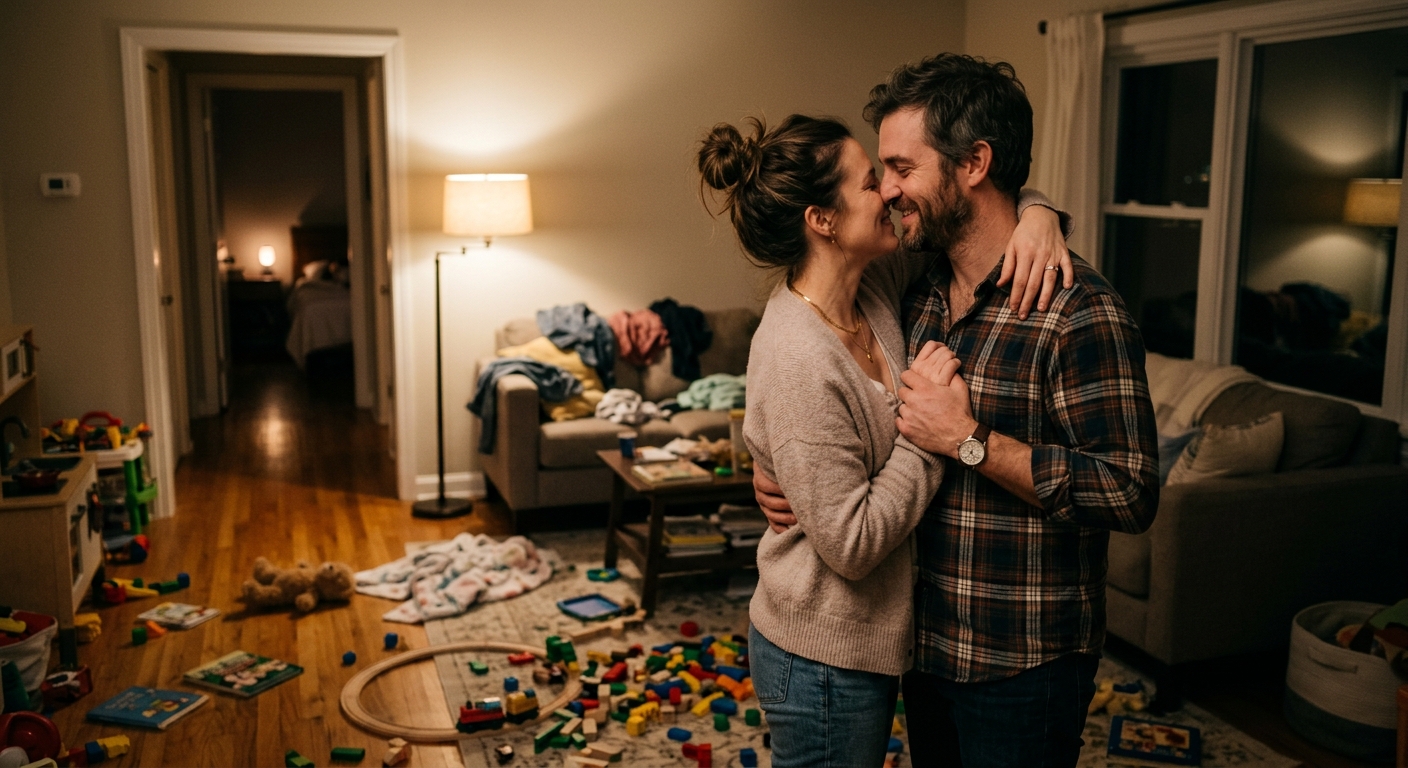
Parenting will always compete for your attention. The school runs won’t slow down. The bedtimes will carry on. The chaos of family life is not a phase you get through and then return to some prior version of yourselves. It becomes the shape of your life. And within that shape, your relationship either gets intentional care or it quietly fades into the background.
The parents who keep their connection alive aren’t the ones with more time or more money. They’re the ones who keep choosing each other in the time they have. A long hug before the day kicks off. A real conversation that isn’t about the kids. An anniversary acknowledged with thought rather than panic. A moment carved out in the middle of the chaos where it’s just the two of you, remembering why you built all of this together in the first place.
That’s what romance looks like now. And it’s no less real for being quieter than it used to be.